
Subscribe to continue reading
Subscribe to get access to the rest of this post and other subscriber-only content.
"Encouraging Men and Women to Walk in a Personal Relationship with God!"
Subscribe to get access to the rest of this post and other subscriber-only content.
To listen to the audio recording for this article, please >>Click Here<< to go to our YouTube page!
2nd Samuel 12:1-14 And the LORD sent Nathan unto David. And he came unto him, and said unto him, There were two men in one city; the one rich, and the other poor. (2) The rich man had exceeding many flocks and herds: (3) But the poor man had nothing, save one little ewe lamb, which he had bought and nourished up: and it grew up together with him, and with his children; it did eat of his own meat, and drank of his own cup, and lay in his bosom, and was unto him as a daughter. (4) And there came a traveller unto the rich man, and he spared to take of his own flock and of his own herd, to dress for the wayfaring man that was come unto him; but took the poor man’s lamb, and dressed it for the man that was come to him. (5) And David’s anger was greatly kindled against the man; and he said to Nathan, As the LORD liveth, the man that hath done this thing shall surely die: (6) And he shall restore the lamb fourfold, because he did this thing, and because he had no pity. (7) And Nathan said to David, Thou art the man. Thus saith the LORD God of Israel, I anointed thee king over Israel, and I delivered thee out of the hand of Saul; (8) And I gave thee thy master’s house, and thy master’s wives into thy bosom, and gave thee the house of Israel and of Judah; and if that had been too little, I would moreover have given unto thee such and such things. (9) Wherefore hast thou despised the commandment of the LORD, to do evil in his sight? thou hast killed Uriah the Hittite with the sword, and hast taken his wife to be thy wife, and hast slain him with the sword of the children of Ammon. (10) Now therefore the sword shall never depart from thine house; because thou hast despised me, and hast taken the wife of Uriah the Hittite to be thy wife. (11) Thus saith the LORD, Behold, I will raise up evil against thee out of thine own house, and I will take thy wives before thine eyes, and give them unto thy neighbour, and he shall lie with thy wives in the sight of this sun. (12) For thou didst it secretly: but I will do this thing before all Israel, and before the sun. (13) And David said unto Nathan, I have sinned against the LORD. And Nathan said unto David, The LORD also hath put away thy sin; thou shalt not die. (14) Howbeit, because by this deed thou hast given great occasion to the enemies of the LORD to blaspheme, the child also that is born unto thee shall surely die.
How would you define a “faithful” person? The wise man, Solomon, tells us in Proverbs 14:5 A faithful witness will not lie… and again in Proverbs 27:6 Faithful are the wounds of a friend… and he asks in Proverbs 20:6 …a faithful man who can find?
It seems that Solomon looked at a faithful person, not as someone who faithfully toes the line to stay in good standing and to gain advantage, but as someone who, when it’s necessary, is willing to take on great risk to themselves and their reputation in order to speak truth; not just for the sake of calling things out, but with a much deeper reasoning…the hope of righting some wrong that is creating a negative impact on others. Such a man was the prophet Nathan!
What God considers to be faithful and what people consider to be faithful can be two very different things! Nathan was convicted by Jehovah to go and deliver a difficult message to the king. It would be a message that would no doubt be unpopular with those who surrounded the king and maybe even with the king himself. But, Nathan knew the message had to be delivered.
Nathan’s Divine Mission
2nd Samuel 12:1 And the LORD sent Nathan unto David…
The king, being the highest position in the land, was probably not used to anyone being so bold and forward with him. He was probably use to platitudes and placating language that would almost guarantee their place in the king’s good graces. But, Nathan knew his message was ordained by God and therefore feared God alone rather than fearing what the king, or anyone else, could do to him.
We call Nathan faithful, not only because he was faithful to God in delivering this very heavy message when others would have chosen to stay silent, but, we call him faithful because he was also faithful to David.
When Nathan could have chosen his own self-interests over the will of God; when he could have chosen to go his own way and “mind his own business”, which in turn would likely have allowed David to incur the wrath of God in a much more severe way, he chose to deliver the message, suffer the possible displeasure of the king, and at least give the king the opportunity to hear it from someone rather than letting David remain in ignorance and suffer the consequences.
God’s Message Through Nathan Did Not Happen Right Away
We have to remember that Nathan delivered his message to the king just before the illegitimate child of David and Bathsheba was born. So, we’re talking about nine months or so from the time of David’s sin with Bathsheba to the time Nathan delivers his message.
During this time, there were those around David who knew about this situation. 2nd Samuel 11:3-4 And David sent and enquired after the woman. And one said, Is not this Bathsheba, the daughter of Eliam, the wife of Uriah the Hittite? (4) And David sent messengers, and took her; and she came in unto him, and he lay with her…
We don’t read of anyone telling David that his actions were wrong in the eyes of God or that this action was going to hurt other people…why not? Maybe it’s because they thought the king was out of their reach. Maybe some feared losing promotional opportunity if they said something. Who knows? Again, what God considers to be faithful and what people consider to be faithful can be two very different things!
Even Joab started to realize something was amiss. Consider the following scriptures:
So, we see that the error of David had been going on for a while and others were aware of it and that it was wrong. But, only Nathan would have the wherewithal to actually speak up about it, not to harm David, but to help him and all who were affected by his actions.
During this nine months or so, could David play the trumpet and harp with joy unto the Lord? Could he say With my whole heart have I sought thee…(Psalms 119:10)? Not likely!
What a joyless year he must have experienced! So it is when we are fighting against the conviction of God Himself! To fight against the only true joy-giver is to ensure that no joy is experienced, but rather the slow painful process of a dying spirit…as I’m sure David must have been experiencing!
Nathan understood that reproof, especially of someone who resides at a higher social level such as king David, should only be presented according to the will of God; not according to who deserves it nor according to one’s own whims. This calling requires careful prayer and consideration before it is carried out.
When Nathan understood this to be the will of God, he humbly obeyed. We do not find that he delivers the message with a spirit of retribution or to attack. But, it is delivered in the spirit of duty to the Lord. This way the response of the king and any possible rejection of those around him would have no bearing on his obedience.
Nathan brings this message to a climactic close when he tells David in 2nd Samuel 12:14 Howbeit, because by this deed thou hast given great occasion to the enemies of the LORD to blaspheme… In other words, “It isn’t just about you and protecting your image…you have given the enemies of God ammunition, not only to use against you personally, but also to use against what God is trying to do through you, and now our people are suffering and have to work harder to overcome that stigma!”
David’s Favorable Response
When Nathan told David those famous words in 2nd Samuel 12:7 …Thou art the man…, we don’t read of David trying to come up with a reason why he wasn’t to blame. He simply said …I have sinned against the LORD…(2nd Samuel 12:13).
When Nathan was tasked to deliver this message, it was never in the heart of God nor in the heart of Nathan to try to hurt David. Nathan’s faithfulness is found, not only in that he delivered a difficult message to the highest ranking person in the land, but also in that he meant it for David’s good. Nathan had too much conviction to just let this wrong go on as others seem to have been doing.
2nd Samuel 12:15 And Nathan departed unto his house… After delivering the message God sent him to deliver, Nathan did not stand around to see if David would take notice of his good intentions and reward him for his bravery and faithfulness to God. David needed Nathan more than he realized!
Obeying the Lord was all the reward Nathan needed! He could say as the prophet Daniel would later say in his generation in Daniel 5:17 Then Daniel answered and said before the king, Let thy gifts be to thyself, and give thy rewards to another…
We can rightly say that the prophet Nathan was a faithful reprover because he was faithful to God and faithful to the one to whom God sent him. Only the love of God in someone’s heart can help them have sympathy and love for someone they must deliver a strong message to; especially if that person is someone they once greatly respected!
This site is dedicated to Encouraging Men and Women to Walk in a Personal Relationship with God. If this article has added value to your life for God, consider subscribing by >>Clicking Here << and subscribing to our YouTube page by >> Clicking Here <<.
Thank you!

Bible Reading: Matthew 22:34-40 But when the Pharisees had heard that he had put the Sadducees to silence, they were gathered together. (35) Then one of them, which was a lawyer, asked him a question, tempting him, and saying, (36) Master, which is the great commandment in the law? (37) Jesus said unto him, Thou shalt love the Lord thy God with all thy heart, and with all thy soul, and with all thy mind. (38) This is the first and great commandment. (39) And the second is like unto it, Thou shalt love thy neighbour as thyself. (40) On these two commandments hang all the law and the prophets.
Text: Matthew 22:40 On these two commandments hang all the law and the prophets.
This lawyer was called by Mark “a scribe” in Mark 12:28 And one of the scribes came, and having heard them reasoning together, and perceiving that he had answered them well, asked him, Which is the first commandment of all? Such were teachers and expounders of the Mosaic Law (Law of Moses).
This man was put forth by the Pharisees as an expert with the hopes that he would not be easily confused by Jesus as the Sadducees apparently had. Matthew 22:34 But when the Pharisees had heard that he had put the Sadducees to silence, they were gathered together. “Wow, if this Jesus can answer questions so thoroughly that they run out of excuses for questioning Him, let me go hear Him too!”
By tempting Jesus, they were trying Him; putting Him to the test. On the lawyer’s part , this may or may not have been altogether maliciously, but maybe it was also from curiosity, and partly from a desire to hear Christ’s opinion on a much disputed point…Matthew 22:36 Master, which is the great commandment in the law?
It seems that Christ was pleased with this man personally, for he said to him, “Thou art not far from the kingdom of God.” Those who put this lawyer forward probably had sinister motives, but the man himself seems to have been straightforward and honest.
Giving Others a Chance
One of our initial motivations for getting saved is so that, rather than inheriting eternal damnation, we inherit eternal life through Jesus Christ. This is a good starting point, but from there we tend not to think of anyone else other than ourselves…Our salvation…Our walk with God…Our blessings.
When is the last time you gave someone a chance to also hear the Gospel, either by explaining it to them, or at least inviting them to the house of God where they can also hear the Gospel and how to get saved?
What Jesus explains here as the two greatest commandments are not even written in the 10 Commandments at all…not in this way. This is because Jesus is explaining the spirit of the commandments of God.
This is How Churches Grow
The proper way of looking at “our church” is that “our church is this part of the kingdom of God, not the whole kingdom of God”. That takes the focus off of us and puts it on God and on other people…those we are supposed to be loving more than we love ourselves.
Dying to Ourselves
True salvation is not just adding Jesus into our lives. It is dying on the cross with Him, and taking His resurrected eternal life with us, and leaving our old lives hanging on the cross!
The only person who can give eternal life is the One who already has it and is therefore able to give it! Only God in His goodness and grace possessed the willingness and the ability to leave Heaven, endure Hell, and to do it for His enemies.
We do not even possess the willingness or ability to do this for someone because 1) we had no Heaven to leave and 2) we probably wouldn’t do it if we did. We may say that we would, but that’s only because we know that we don’t have to actually carry it out.
Romans 5:7-8 For scarcely for a righteous man will one die: yet peradventure for a good man some would even dare to die. (8) But God commendeth his love toward us, in that, while we were yet sinners, Christ died for us.
Let us remember that, while we’re striving to keep God’s written commandments, there are two commandments that encapsulate all of God’s commandments…love God and love others!
This site is dedicated to Encouraging Men and Women to Walk in a Personal Relationship with God. If this article has added value to your life, consider subscribing by >>Clicking Here<< and subscribing to our YouTube page by >>Clicking Here<<.
Thank you!
You can listen to the audio version of this article on the go by >>Clicking Here<<.
Matthew 28:19-20 Go ye therefore, and teach all nations, baptizing them in the name of the Father, and of the Son, and of the Holy Ghost: (20) Teaching them to observe all things whatsoever I have commanded you: and, lo, I am with you alway, even unto the end of the world. Amen.
“teach” – Greek matheteuo (math-ayt-yoo-o); to instruct as a student; to make into a disciple.
Though the word “disciple” is used almost 30 times in the New Testament and the word “teach” is used more than 30 times, this particular form is only used four times. It is found in the following scriptures:
So, we see the way Jesus uses this word “teach” is meant to convey a very specific meaning and intention from the Lord. The Lord Himself commands every minister He calls, not to just make church service attendees or program participants, but to go and make disciples out of everyone from every place that they can.
A disciple is someone who learns to discipline themselves to both learn and apply the teachings of another person. We take notice that this command to go and make disciples does not carry with it a guarantee that all who hear the teachings of Christ will allow themselves to be developed into a disciple of Christ. The command is simply to go and start the process through teaching.
If the minister will do their part, then Jesus tells us in verse 20 of the Bible reading that He will do His part, when He says …and, lo, I am with you alway, even unto the end of the world. It is then incumbent upon the hearer of God’s word to do their part which is to be …instructed unto the kingdom of heaven…(Matthew 13:52)
Insight and Foresight
In order to properly make someone into a disciple of Christ, as instructed by Jesus, there must be insight and foresight, and both of these come from God. The insight has to do with knowing what to teach from God’s word, how to teach it, and when to teach it.
The foresight is the ability to be able to see, from the beginning, not just the next step, but where it is that God would like the minister to ultimately guide the one they are teaching. It means to have a forward-looking vision on behalf of the one who is being taught.
In other words, having a pathway forward for the one being taught that reaches beyond simply attending services just for the sake of attending services.
Remember, the Lord doesn’t teach us to simply create church service attendees or program participants, but to teach people how to meaningfully apply the word of God to their personal lives so that they grow and develop spiritually.
Developing Spiritual Fruit
Remember in Mark 4 where Jesus is teaching about the parable of the sower? He says in Mark 4:8 And other (seeds) fell on good ground, and did yield fruit that sprang up and increased; and brought forth, some thirty, and some sixty, and some an hundred.
He then clarifies that the sower is the teacher of God’s word and the seed is God’s word in Mark 4:14 The sower soweth the word.
Then He completes the thought in Mark 4:20 And these are they which are sown on good ground; such as hear the word, and receive it, and bring forth fruit, some thirtyfold, some sixty, and some an hundred.
The fruit spoken of by Jesus is spiritual fruit that develops in people’s lives. This spiritual fruit is itemized for us by the Apostle Paul in Galatians 5:22-23 But the fruit of the Spirit is love, joy, peace, longsuffering, gentleness, goodness, faith, (23) Meekness, temperance: against such there is no law.
Have you ever wondered how to apply the fruit of the Spirit to your life? Jesus told us in Mark 4:20 …such as hear the word, and receive it, and bring forth fruit…
Through the verses we’ve discussed, we are given a step-by-step process of what making a disciple looks like.
It has been my experience that when someone truly hungers and thirsts for the word of God and His righteousness,…they shall be filled. (Matthew 5:6)!
Going and teaching all nations is a joint effort between the minister and the disciple and when both are doing their parts, great spiritual fruit is produced in both of their lives!
This site is dedicated to Encouraging Men and Women to Walk in a Personal Relationship with God. If this article has added value to your life, consider subscribing by >>Clicking Here<< and subscribing to our YouTube page by >>Clicking Here<<.
Thank you!
Romans 5:5 And hope maketh not ashamed; because the love of God is shed abroad in our hearts by the Holy Ghost which is given unto us.
Because of what Jesus did for us by opening to us the way of salvation from sin and God’s wrath, we are accepted with God and we now have peace with God. Whereas before, we had fear of the judgment to come, we are going to see how it is that we not only have access to a personal relationship with God, but we will also learn how to make the most of that relationship!
Romans 5:2 By whom also we have access by faith into this grace wherein we stand, and rejoice in hope of the glory of God.
We don’t just come in for an interview with God at salvation, never to meet Him again, but we now have full open door access to Him at all times! We have access to God and to His grace and favor.
Romans 5:3 And not only so, but we glory in tribulations also: knowing that tribulation worketh patience given unto us.
We’re not destroyed by tribulation, nor do we have to praise God for it, but we praise God in the tribulation and are refined by it as gold is refined by the fire. Many times we view tribulation as a sign of God’s displeasure, but tribulation is also a token of His Fatherly love as a means of purifying us from our spiritual weaknesses.
“tribulation worketh patience” – when you’ve been through the fire, the next time you go through it you know “this too shall pass” and thus you become more patient with the process of purifying the next time you go through it.
Romans 5:4 And patience, experience; and experience, hope:
As we are patient in our tribulation, we gain experience with God and we gain the experience of God’s grace, power, and faithfulness to us so that we don’t feel shame as if He has forgotten us or let us down.
Many times, it seems that when people are serving God and they go through times of tribulation, they start to believe that God has failed them because things are not going as they had hoped they would.
Many people may even quit before their experience was fully developed and they never get to see what God was trying to do in their lives!
God does not expect us just to be faithful to Him, but He wants us to expect Him to be faithful to us as well. Don’t let your times of trial be a waste of time…learn something while you’re there, even if what you learn is something new about yourself!
“and experience, hope” – Hope in God’s delivering power is formed by experiences, which takes patience to successfully endure! When you know God has come through for you before, you have a sincere hope that He’ll do it again and you’re not ashamed of having to wait because you know God hasn’t forgotten about you!
While you’re waiting on God to bring you through your tribulation, there’ll be times people may say to you, as they said to the Psalmist in Psalm_42:3 …Where is thy God?
Being able to say, “I’ve been through something like this before and God brought me out”, gives you hope the next time that He will do the same thing again as you stay faithful to Him. Your experience may even be the very thing someone else needs to hear when it’s their time to go through the purifying process of tribulation.
Romans 5:5 And hope maketh not ashamed; because the love of God is shed abroad in our hearts by the Holy Ghost which is given unto us.
The boldness to not be ashamed of Jesus, or His words while waiting on Him, is only accomplished in us by the power of God the Holy Spirit. The Holy Spirit is a gift from God and the love of God is a gift from God.
The Christian life is an ever-evolving life, being made conformable into the image of Jesus Christ, and we’ll always need God’s grace, love, and strength to make these changes in us!
Romans 5:6 For when we were yet without strength, in due time Christ died for the ungodly.
Paul brings this part of the message to an encouraging conclusion by saying, “If Jesus Christ went all the way to death for you when you were ungodly, then He’ll walk through any tribulation with you, especially now that you’ve been made Godly!!”
Take courage that if you’re purposing to walk with God, then He is purposing to walk with you!
Romans 1:16-17 For I am not ashamed of the gospel of Christ: for it is the power of God unto salvation to every one that believeth; to the Jew first, and also to the Greek. (17) For therein is the righteousness of God revealed from faith to faith: as it is written, The just shall live by faith.
In the book of Romans God, through Paul the Apostle, is establishing the basics of Christianity. He establishes a foundation before building thereon, and makes it clear that the foundation of God’s eternal plan is Jesus Christ! 1 Corinthians 3:11 For other foundation can no man lay than that is laid, which is Jesus Christ. Paul establishes early in this letter that he is not ashamed of the gospel message he is proclaiming and he gives some reasons why that is. Gospel – Greek euaggelion; the good message.
God wants to take away the devil’s weapons of shame and embarrassment, and hopefully replace them with complete confidence about proclaiming the gospel message of Jesus Christ through our everyday lives! We are going to look at Paul’s reasons for not being ashamed and hopefully apply these same reasons to our lives as well.
The Gospel of Christ is the Power of God
Romans 1:16 For I am not ashamed of the gospel of Christ: for it is the power of God unto salvation…
“unto salvation” – The direct aim of the gospel is to bring salvation from the penalty and power of sin to all who will receive its message, and sanctification for the rest of our lives after that. One reason not to be ashamed of the gospel of Christ is that it is the power of God!
“To everyone that believeth“
This removes dependence all works of the flesh and external works. Ephesians 2:8-9 For by grace are ye saved through faith; and that not of yourselves: it is the gift of God: (9) Not of works, lest any man should boast. This is one reason simply believing is not enough. People quickly rely on the fact that “I believe in God”…who does the believing? “I do”
Another reason simply believing is not enough is found in James 2:19 Thou believest that there is one God; thou doest well: the devils also believe, and tremble. All it takes is sincere faith and reliance on Christ from Luke 8:15 …an honest and good heart…in the power of Christ alone. One reason not to be ashamed of the gospel of Christ is that it is the power of God to everyone that believeth!
The Gospel of Christ is for everyone equally
Salvation and then sanctification are available to everyone. This concept is captured in the phrase “to the Jew first, and also to the Greek”. The Bible says John 3:16 For God so loved the world…, but then the Bible says James 4:4 …whosoever therefore will be a friend of the world is the enemy of God. 1 John 2:15 Love not the world, neither the things that are in the world…
This is because salvation is available to those who may have bitter opposition toward other people or even toward God Himself! God’s salvation can heal bitterness! One reason not to be ashamed of the gospel of Christ is that in the Gospel is the power of God that is extended to everyone equally!
The Gospel of Christ Gives Revelations
Revelations About God’s character
“for therein is the righteousness of God revealed”. John Wesley – “This expression sometimes means God’s eternal, essential righteousness, which includes both justice (judging sin) and mercy (forgiving sin), and is eminently shown in condemning sin, and yet justifying the sinner.”
God is righteous because He measures out sufficient mercy and proper judgment. God’s mercy goes ahead and prepares the way for His judgment. How? By making known to us the impending judgment of God upon sin and offering to help us get out of the way…by faith in Christ and true repentance! It’s by His righteousness that He judges sin! It’s by His mercy that He warns us! It’s by His grace that He delivers us!
Revelations about God’s method of revealing truth
“from faith to faith” – in other words “from truth to truth”. God’s method of revealing His truth to us is to do it step by step, one truth at a time. As we embrace the truth that is presented before us, whatever that truth may be at the time, we may then take the next step with God into deeper truth.
It could be a Biblical truth we are to implement, it could be a personal truth we are to deal with, it could be a truth about God Himself, or any other kind of truth that God deals with us about at the moment!
God does NOT heap every truth on us at once nor does He expect us to know everything in order that we may follow Him…we simply walk with God one truth at a time! Another reason not to be ashamed of the Gospel of Christ is because of the Gospel’s revelations!
The Gospel of Christ Gives Assurances
Assurances of our acceptance with God
“…as it is written, the just shall live by faith”. Paul reaches all the way back and quotes Habakkuk_2:4 …the just shall live by his faith. Even in Habakkuk’s day, there were people who were proud and who lifted up themselves against God’s truth. They were not as upright (holy) as they pretended they were. But, they who are justified, and have submitted to the divine judgments of God, shall live by their faith and not die like those who lift themselves up against God!
Assurances of being able to please God
John 8:29 …for I do always those things that please him. 1 John 4:4 Ye are of God, little children, and have overcome them: because greater is he that is in you, than he that is in the world.
If the Overcomer and Conqueror lives in us, then we are made Romans 8:37 …more than conquerors through him that loved us. If you try to please God by yourself, you have a long road ahead of you, but with Jesus in us, we can please God and the gospel shows us how!
Assurances of eternal life
Yet another reason not to be ashamed of the gospel of Christ is because of the Gospel’s assurances of eternal life!
Conclusion:
The Gospel (good news message) is that which delivers to us all we need to know in order to make it Heaven and be victorious on our way there! Never be ashamed of that which draws you closer to God and makes you more like Jesus!

Ephesians 3:18 May be able to comprehend with all saints what is the breadth, and length, and depth, and height;
Here in verse 18, Paul makes what seems like an incomplete thought. After reading this verse, you’re left wondering, “The ‘breadth, and length, and depth, and height’ of what?”.
Some say he means the love of Christ that he’s getting ready to talk about, but that can’t be the case because he says in Ephesians 3:19 And to know the love of Christ, which passeth knowledge, that ye might be filled with all the fulness of God. The use of the word “And” indicates that this thought is an addition and therefore he must be referring to something else.
It seems likely that Paul is referring back to what he says in Ephesians 3:10 …might be known by the church the manifold wisdom of God. Paul is simply stating that he desires that the church (the body of believers in Christ) would know the manifold (multi-faceted) wisdom of God. I say this because there seems to be an interjection of multiple thoughts between verses 10 & 18.
In verse 10 Paul mentioned the manifold wisdom of God and then from verses 11 – 17 he shares 10 insights about the wisdom of God just to show how multi-faceted it really is:
After this, Paul seems to come back to where he left off in verse 10, by declaring in verse 18 that he wishes the church understood the breadth, length, depth, and height of God’s wisdom. After presenting this list to the reader, it’s as if he declares, “I wish you understood how multi-faceted the wisdom of God really is!”
Notice in verse 18 the order given to us by Paul. Many people want to go straight to the height of God’s wisdom before understanding the breadth, length, and depth of God’s wisdom.
God says through the prophet Isaiah in Isaiah 55:8-9 For my thoughts are not your thoughts, neither are your ways my ways, saith the LORD. (9) For as the heavens are higher than the earth, so are my ways higher than your ways, and my thoughts than your thoughts.
All of this is what Paul and God want us to understand today; that God’s wisdom does not always work according to the understanding of people. One act of grace is that God is willing to give understanding to those who seek Him for it.
Are you seeking to operate in the grace of God’s wisdom?
This site is dedicated to Encouraging Men and Women to Walk in a Personal Relationship with God. If this article has added value to your life, consider subscribing by >>Clicking Here<< and subscribing to our YouTube page by >>Clicking Here<<.
Thank you!

Matthew 17:1-3 And after six days Jesus taketh Peter, James, and John his brother, and bringeth them up into an high mountain apart, (2) And was transfigured before them: and his face did shine as the sun, and his raiment was white as the light. (3) And, behold, there appeared unto them Moses and Elias talking with him.
This event in scripture is what is known as “The Mount of Transfiguration”. This is not the name of the physical location, but of the event that took place there.
The word “transfigured”, from the Greek word metamorphoo (think of the word “metamorphosis”) means to be changed from one condition or state to another. This Greek word is only used here and three other places. Mark 9:2 – …and He was transfigured before them. Romans 12:2 – …be ye transformed by the renewing of your mind…, and 2nd Corinthians 3:18 – …changed into the same image from glory to glory. We notice that in Matthew 17:2 and Mark 9:2, Jesus is transfigured. In Romans 12:2 and 2nd Corinthians 3:18, we are to be transfigured.
Notice, it was Jesus who took them into the high mountain. Matthew 17:1 And after six days Jesus taketh Peter, James, and John his brother, and bringeth them up into an high mountain apart.
They did not take themselves and we cannot take ourselves into the high mountain of God’s presence. We can begin to climb through personal prayer and study of His word, but it is God alone who brings us higher into that mountain with Him.
Climbing the Mountain of Transfiguration
In order to be ready to climb a mountain, you must be conditioned for it. So it is with going into the high mountain of God’s presence. You must be spiritually conditioned for it. This means more time communing with God in the prayer closet and in the word of God. This form of spiritual training is work for the flesh and spirit.
This is why most people are not conditioned for this kind of spiritual climbing. The disciples in Matthew 17 may have been physically conditioned to climb the mountain, but Jesus was training them to be spiritually conditioned to climb a different kind of mountain; the mountain of being alone in God’s presence.
What They Saw in the Mountain
Matthew 17:2-3 And was transfigured before them: and his face did shine as the sun, and his raiment was white as the light. (3) And, behold, there appeared unto them Moses and Elias talking with him.
While they were in the mountain with Jesus, the disciples saw things they had never seen before. They saw a glimpse of the glory of Christ returned to Him for a short moment. They saw Moses and Elijah talking with Jesus.
At this point in their lives, they had only heard of Moses and Elijah, but now they were seeing them personally. This experience no doubt left an indelible mark upon the disciples’ hearts and solidified their faith in Jesus as the true Messiah!
While God is not obligated to give us this same kind of experience when we go up into the mountain of prayer with Him, one thing is for sure, we have far more of a chance of seeing God’s glory when we go up into that high mountain with God, than we would if we stayed down at the base with everyone else.
Rather than saying, “Okay, gotta go pray and read the Bible”, start saying, “I wonder what God will show me and what He will say to me this time!”. That would be a powerful paradigm from which to live our Christian lives!
They Were Moved to Do a Work for God
Matthew 17:4 Then answered Peter, and said unto Jesus, Lord, it is good for us to be here: if thou wilt, let us make here three tabernacles; one for thee, and one for Moses, and one for Elias.
We see here the effect of being in the presence of God; the disciples wanted to do a work for God! I believe people’s lack of desire to be part of what God is doing on the earth is directly related to their lack of time invested in the high mountain of God’s presence.
I believe God would bring them up higher if they would just start to climb. Too many people are content at the base camp of religious familiarity to put on their spiritual hiking boots and start to climb higher!
We should not go into God’s presence expecting or demanding to see a great light from Heaven. Rather, go into God’s presence to give Him praise and worship and then to just be there. As Peter said, “…it is good for us to be here”.
The Vision Is Not for Everyone
Matthew 17:9 And as they came down from the mountain, Jesus charged them, saying, Tell the vision to no man, until the Son of man be risen again from the dead.
Not everything you hear and see while in the mountain with God will He give you liberty to share with everyone else. Sometimes, it’s just for you! Jesus told these three disciples not to share what they had seen until a certain time.
This shows that God must trust you not only to bring you up into the mountain with Him, but also after you have left the mountain!
Are you willing to make the spiritual climb into the high mountain apart in order to be with the Lord?
If this article has added value to your walk with God, consider subscribing to our blog by >>Clicking Here<< and subscribing to our YouTube page by >>Clicking Here<<.
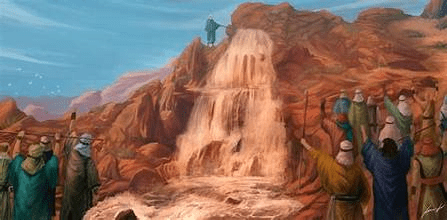
Numbers 20:11 And Moses lifted up his hand, and with his rod he smote the rock twice: and the water came out abundantly, and the congregation drank, and their beasts also.
Leading up to this verse, Moses had just been given a specific command by God. Numbers 20:7-9 And the LORD spake unto Moses, saying, (8) Take the rod, and gather thou the assembly together, thou, and Aaron thy brother, and speak ye unto the rock before their eyes; and it shall give forth his water, and thou shalt bring forth to them water out of the rock: so thou shalt give the congregation and their beasts drink. (9) And Moses took the rod from before the LORD, as he commanded him.
Moses knew what God wanted him to do and how God wanted him to do it. So far so good, right?
We then see that Moses allowed an angry spirit to affect him. Numbers 20:10 And Moses and Aaron gathered the congregation together before the rock, and he said unto them, Hear now, ye rebels; must we fetch you water out of this rock? The preacher was mad and he was letting the people know it!
Numbers 20:11 And Moses lifted up his hand, and with his rod he smote the rock twice: and the water came out abundantly, and the congregation drank, and their beasts also.
When Moses struck the rock, a LOT of water flowed from it and a lot of people were blessed by it. The problem is that he disobeyed the Lord in the process of getting those results. Notice that even in his disobedience, he appeared to have great success.
As God’s people, and especially His ministers, we cannot be willing to do things that God does not approve of in order to get something flowing and “bless” a lot of people. First, and most importantly, it is never a good idea to walk in disobedience to the Lord, no matter the immediate effects it brings. Secondly, when this is done, it tends to only attract those who, like those in the wilderness with Moses, are takers and not contributors.
“As God’s ministers, we cannot verbally strike people in anger. We must speak to people and let the Holy Spirit strike their hearts.”
In verse 10, Moses said “…must we fetch you water out of this rock?”. If we are not careful, we too can fall under the same influence of the spirit of self-will. Moses, in his anger, verbally struck the people, and physically struck the rock. Paul later tells us in 1st Corinthians 10:4 …and that Rock was Christ.
As God’s ministers, we cannot verbally strike people in anger. We must speak to people and let the Holy Spirit strike their hearts. As Paul the Apostle points out in Ephesians 4:15 But speaking the truth in love…
We often think that Moses was kept out of the Promise Land because he struck the rock instead of speaking to it like God commanded. He did do this and it was part of his disobedience, but only the visible part.
Notice afterwards, God did not focus on how many people were “blessed” by all the water coming out of the rock. God didn’t even bring up the fact that Moses struck the rock instead of speaking to it. God focused on the unbelief of Moses and lack of glory given to God.
Numbers 20:12 And the LORD spake unto Moses and Aaron, Because ye believed me not, to sanctify me in the eyes of the children of Israel, therefore ye shall not bring this congregation into the land which I have given them.
Moses’s disobedience was not only in striking the rock, but it was also in not believing and sanctifying (glorifying) God in the eyes of the children of Israel. It was because of this that Moses and Aaron were kept out of the Promised Land.
Incidentally, Moses and Aaron not being allowed to bring the people of God into the Promise Land also illustrates to us how that the Law of Moses and Priesthood of Aaron cannot bring people into the Promise Land of Heaven. Neither of these systems produce true belief (saving faith) nor do they sanctify (give glory to) God. Only the Priesthood of Jesus Christ can do that!
So, we see that Moses appeared to be successful even while he was in disobedience. He verbally struck the people, he physically struck the rock, which was Christ, and he did not believe nor give glory to God. He took the glory for himself.
Let us learn from this occasion and ensure that we do not Hebrews 4:11 …fall after the same example of unbelief.
If this article has added value to your walk with God, consider subscribing to our blog by >>Clicking Here<< and subscribing to our YouTube page by >>Clicking Here<<.

Proverbs 3:3-4 Let not mercy and truth forsake thee: bind them about thy neck; write them upon the table of thine heart: (4) So shalt thou find favour and good understanding in the sight of God and man.
We are to ensure that we do not allow mercy and truth to slip away from us and be replaced with worldliness. Let them be as a chain around your neck and as written on your heart so they go wherever you go
You need mercy and truth; not just mercy because having only mercy will allow all manner of compromise. This can cause you to think that making people happy is the goal. You also cannot just have truth because having only truth can be rigid and you’ll think keeping rules is equivalent to holiness and righteousness.
“So shalt thou find favour…” When you learn to balance mercy and truth, you will have favor with God and with people. You will find favor with God because God will see you standing firmly on the truth while treating people as you should. You will have favor with people because people will see you as someone who stands firmly on the truth while giving mercy because you give space and allowance for spiritual growth.
“So shalt thou find…and good understanding in the sight of God and man.” You will find good understanding with God because God will give you more understanding as you learn this skill of balancing mercy and truth. You will find good understanding with people because you will learn how people actually operate.
Balancing mercy and truth will help Godliness develop in people’s hearts, where it should be developed. In most cases, this will influence the lazy to work, the stubborn to submit, the proud to serve, the angry to forgive, the rigid to show mercy, and the weak to have boundaries.
“…bind them about thy neck…” Bind this obligation upon your neck like a yoke and every time you are faced with a challenging situation, you will remember your responsibility to balance mercy and truth.
If this article has added value to your walk with God, consider subscribing to our blog by >>Clicking Here<< and subscribing to our YouTube page by >>Clicking Here<<.